Every brewing guide begins the same way: "weigh your coffee." And it is true that weight is the most accurate way to measure — coffee beans vary wildly in density, and two scoops of one coffee can weigh fifty percent more than two scoops of another. But here is a secret the equipment-obsessed corner of the coffee world does not advertise: you can brew genuinely good, consistent coffee without a scale. You just need to replace weighing with a small set of volume landmarks and a little discipline.
Whether you are traveling, brewing in an office kitchen, camping, or simply not ready to buy another gadget, the methods below will get you within the margin of "excellent" every time.
The golden ratio, translated
The specialty coffee standard is a brew ratio of about 1:15 to 1:17 — one part coffee to fifteen to seventeen parts water. In kitchen terms, that translates to a very convenient rule of thumb:
One level tablespoon of ground coffee per "cup" of water, where a cup is the small 150 ml teacup measure — or, more practically, two level tablespoons per standard 300 ml mug.
Ground coffee weighs roughly 5 grams per level tablespoon (beans weigh about 6 grams, but grinding adds air). So two tablespoons — about 10 grams — into a 300 ml mug's worth of water lands you at a 1:15 ratio, right in the sweet spot for most methods.
That single sentence is the whole system. Everything else is refinement.
Landmarks: knowing your vessel
The real problem with brewing without a scale is not the coffee — it is the water. "A mug" might mean 250 ml or 450 ml depending on the mug, and pouring by feel alone can easily be off by forty percent. The fix is to measure your vessels once, remember the numbers, and never think about it again.
Spend five minutes with a measuring jug:
- Fill your usual mug. Pour it into the jug. Now you know — say, 320 ml.
- Fill your French press to the top of its metal band. Check the jug. Now you know it holds 750 ml, or five 150 ml "cups" by its own markings.
- Fill your pour-over carafe to its printed lines. Note the numbers.
Write these on a piece of tape near the kettle if your memory is like most people's. From then on, every brew is a simple count: two tablespoons per 300 ml of water, scaled up or down by the vessel you are using.
Calibrating by taste, not just numbers
Ratios and landmarks get you close; your palate closes the loop. The signs of a well-measured brew are consistent: a cup that tastes balanced — sweet first, then bright, with bitterness only in the finish — usually means the ratio and grind are right. A cup that tastes sour and thin wants more coffee or a finer grind; one that tastes harsh and drying wants less or a coarser grind. Learn to read those two signals and you can correct any volume-based brew on the second attempt.
It also helps to standardize one variable at a time as you learn. Change only the grind for a week, then only the ratio, tasting the difference each shift makes. Within a month, the abstract numbers become lived experience: you will know what two tablespoons of a medium roast looks like, what the right pour height sounds like, and how your favorite mug's volume translates into spoons. That embodied knowledge is what "brewing by feel" actually means — not guessing, but knowing.
Method-by-method volume guides
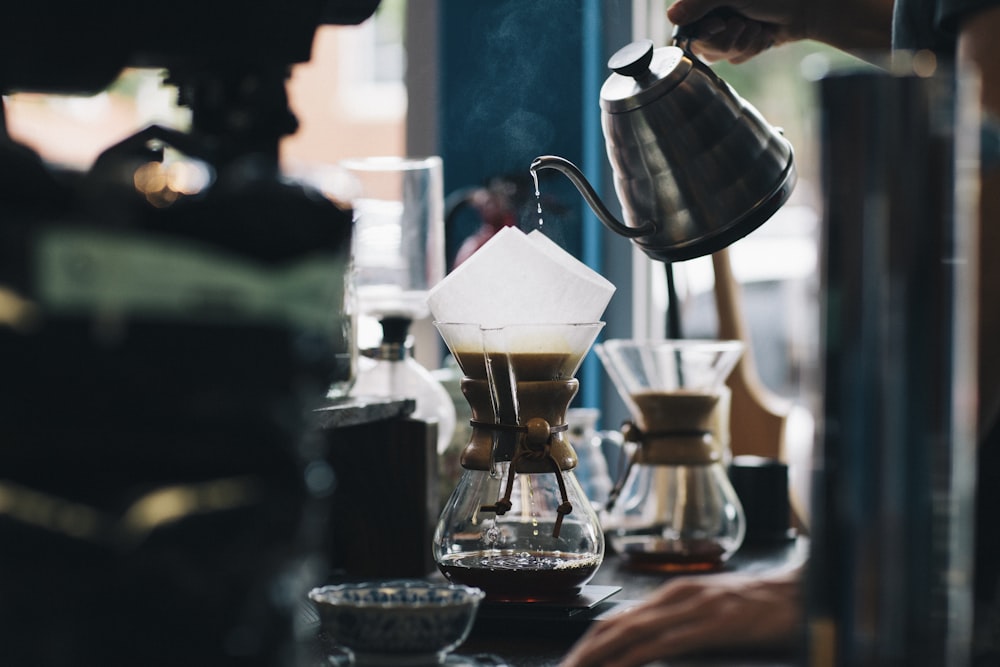
Pour-over (V60, Kalita, Chemex). Use one level tablespoon of medium-ground coffee per 150 ml of water — the small "cup" on your carafe markings. For a standard 2-cup V60 brew (300–330 ml), that is two heaping tablespoons. Bloom with a small splash of water, wait 30 seconds, then pour in slow circles to the full volume, finishing around 2:30–3:00 total.
French press. The press's own cup markings are your friend: one level tablespoon of coarse-ground coffee per marking. A typical 8-cup (1 liter) press takes about 6–7 tablespoons — err toward 7 if you like it fuller. Steep four minutes, break the crust, skim, press gently.
AeroPress. The numbers are printed right on the side, and the scoop that ships with it is calibrated to about 11 grams — nearly perfect. One scoop per cup marking, water to the matching number, steep one to two minutes. The AeroPress is arguably the most forgiving scale-free brewer ever made.
Drip machine. Use the carafe markings, but with a twist: most machine "cups" are 150 ml, and machine baskets reward slightly stronger coffee. One heaping tablespoon per marking is a good start; adjust by one tablespoon in either direction across your first few pots.
Cowboy / camp coffee (just add water). Bring water to a boil, take it off the heat for thirty seconds, add one heaping tablespoon of coarse grounds per mug, stir, wait four minutes, then add a small splash of cold water — which helps the grounds sink — and pour slowly.
The consistency tricks that replace a scale
Without weight, consistency comes from discipline in three places:
- The same spoon every time. Different tablespoons vary. Pick one spoon, measure two tablespoons into your palm once to see what that volume looks like, and use only that spoon.
- The same grind. Grind size changes density — fine grounds pack heavier per spoon than coarse. If you change your grind setting, your spoon measurement shifts too. Keep the grinder consistent and adjust at the spoon level.
- Write down what worked. One line on an index card taped inside a cabinet — "V60: 3 spoons, 500 ml, 3 minutes, good" — is a better brewing journal than most people's memory.
When you are ready for a scale (and when you are not)
A basic coffee scale costs about as much as two bags of good beans and does remove the last variable: it lets you dial in a new coffee precisely, reproduce a perfect brew exactly, and experiment with confidence. If you find yourself brewing daily and wondering why Tuesday's cup was better than Thursday's, a scale is a natural next step.
But it is a refinement, not a requirement. The difference between a carefully volume-measured brew and a weighed brew is smaller than the difference between fresh coffee and stale, between a clean grinder and a dirty one, between water that tastes good and water that does not. Master the big variables with the spoon you already own, and your coffee will be better than most café cups — no batteries required.